
A frank, numbers-driven breakdown of on-site gas generation versus buying cylinders — from over five decades of manufacturing experience.
Sanghi Overseas Team · Oxygen Gas Plant In India · 10 min read
If your business relies on a steady supply of oxygen or nitrogen — whether in a hospital, a steel fabrication shop, a food packaging line, or a pharmaceutical facility — you have been navigating the same decision for years: keep ordering cylinders, or invest in your own on-site Oxygen Gas Plant in India? It seems straightforward, but the real answer depends on volumes, lead times, hidden logistics costs, and a 5–10 year horizon that most cylinder suppliers conveniently never discuss.
At Sanghi Overseas, an associate concern of Sanghi Organization, we have been building and commissioning cryogenic air separation units since the 1960s — with over 1,100 installations across 90+ countries. We are not disinterested observers in this debate, but we will give you the honest numbers and let you decide.
A cylinder fills your tank today. A gas plant fills your balance sheet for the next 20 years.
The True Cost of Cylinders
Cylinders feel inexpensive because the purchase is incremental — you pay per cylinder, per delivery, and the cost blends into operations without anyone doing the annual arithmetic. But when you add up all the components, the picture changes.
The Hidden Number
A mid-scale manufacturer consuming 150–200 cylinders per month typically spends ₹18–28 lakh annually on oxygen alone, when all logistics, rental, and demurrage costs are fully accounted for. Over five years, that is ₹90–₹140 lakh — often enough to own and fully amortise a mid-capacity Oxygen Gas Plant in India.
The Economics of an On-Site Gas Plant
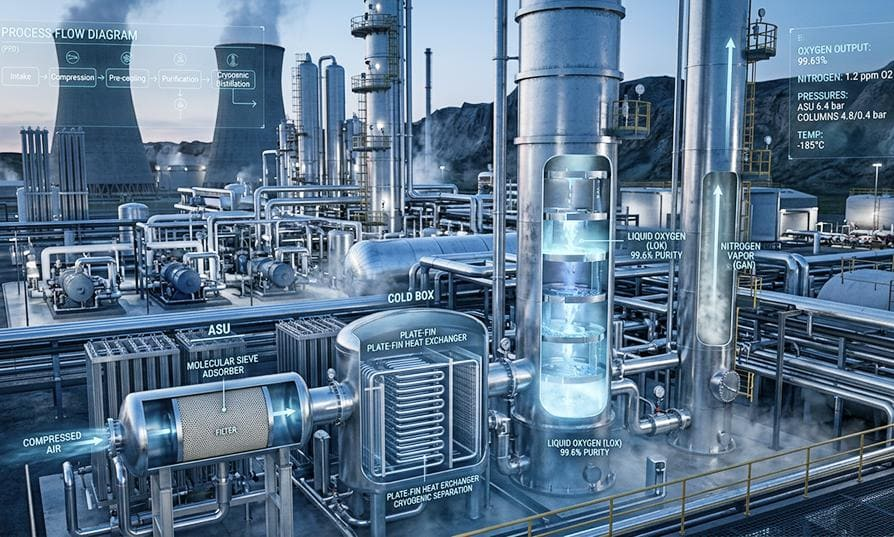
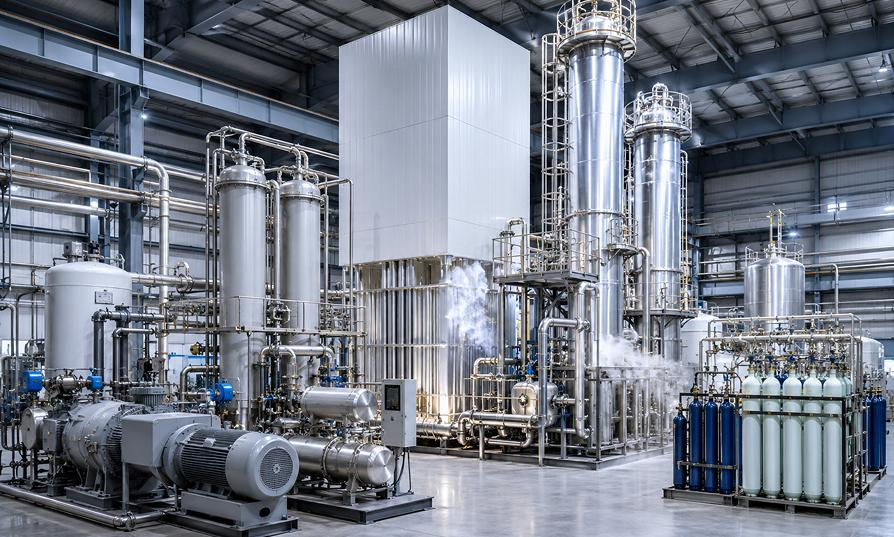
An on-site gas plant — particularly one based on cryogenic air separation technology, which is what Sanghi Overseas designs and manufactures — has a very different cost structure. There is a capital expenditure upfront, and then a steady, predictable running cost dominated by electricity consumption.
Our plants at 250 m³/hr capacity and above operate at approximately 1.0 kWh per m³ of oxygen under normal continuous conditions — one of the lowest energy intensities in the industry. At current industrial electricity tariffs across India (₹6–₹9/kWh in most states), the cost per m³ of produced oxygen is typically well below what the same volume costs in cylinder form, inclusive of all overheads.
Sanghi Overseas Plant — Key Performance Benchmarks
| Parameter | Specification |
|---|---|
| Oxygen Purity | 99.6% |
| Max nitrogen purity | 99.9999% |
| Energy consumption | 1.0 kWh per m3 O2 (250+ capacity) |
| Capacity Range | 40–1500+ m3/hr |
| Restart after defrost | ~8 hours |
| Defrost cycle interval | 9–12 months |
Capital cost versus running cost
Oxygen Plant Cost and Nitrogen Plant Cost vary significantly by capacity. A smaller 80–100 m³/hr plant serves a different buyer profile than a 600–1,000 m³/hr industrial anchor installation. The key financial insight is that capital cost is a one-time event; cylinder spend is perpetual. Our customers consistently find that payback periods fall in the 2.5–4.5 year range at moderate consumption levels, with the plant then running profitably for its full 20+ year operating life.
Head-to-Head Comparison
| Factor | Cylinder Supply | Sanghi Overseas Gas Plant |
|---|---|---|
| Upfront Cost | Low / Nil | Capital investment required |
| Per-unit gas cost | Higher long-term | Lower after payback |
| Supply continuity | Supplier-dependent | 100% in-house control |
| Purity control | Variable by batch | Up to 99.6% O2 / 99.9999% N2 |
| Scalability | Limited by supplier | Custom capacity 40–1500+ m3/hr |
| Dual-gas production | Separate cylinders, separate cost | O2 and N2 simultaneously — no add-on cost |
| Logistics overhead | Ongoing — freight, rental, demurrage | Eliminated after installation |
| Long-term economics | Cost escalates with demand | Cost per m3 falls as output rises |
| Environmental footprint | Cylinder transport emissions | Localised; no transport loop |
| Payback period | N/A | Typically 3–5 years |
Who Should Consider an Oxygen Gas Plant in India?
The business case for an Oxygen Gas Plant in India — or a Nitrogen Gas Plant — is strongest when consumption is consistent and significant. You should be evaluating a plant if any of the following apply:
What Sets Sanghi Overseas Apart
When evaluating Oxygen Plant Cost or Nitrogen Plant Cost, the purchase price is only part of the equation. What you are really buying is two decades of reliable, low-maintenance operation. That is where the quality of the manufacturer and the design of the plant become the decisive variable.
Sanghi Overseas builds all plants on medium operating pressure cryogenic air separation technology, running at just 32–35 kg/cm² during normal operation. This is meaningfully lower than conventional high-pressure designs, which translates directly into reduced power consumption, reduced mechanical stress, and longer service intervals.
DUAL PRODUCTION — NO EXTRA COST One of the most commercially important features of our Oxygen Gas Plant in India is that it produces both high-purity oxygen and nitrogen simultaneously. If your operation uses both gases — as most industrial plants do — you eliminate one of your two cylinder dependencies entirely, effectively halving the Nitrogen Plant Cost from the moment your plant starts up.
1,100+ INSTALLATIONS. 90+ COUNTRIES. Sanghi Overseas has been designing and exporting gas plants since the 1960s, with a track record spanning diverse geographies, climates, and industrial applications. Each plant comes with full commissioning support, operator training, and a planned spare parts programme to ensure decades of reliable operation.
Understanding Oxygen Plant Cost & Nitrogen Plant Cost
We are often asked: 'What is the Oxygen Plant Cost for a plant that covers my requirements?' The honest answer is that it depends on capacity, site conditions, local infrastructure, and specific purity requirements.
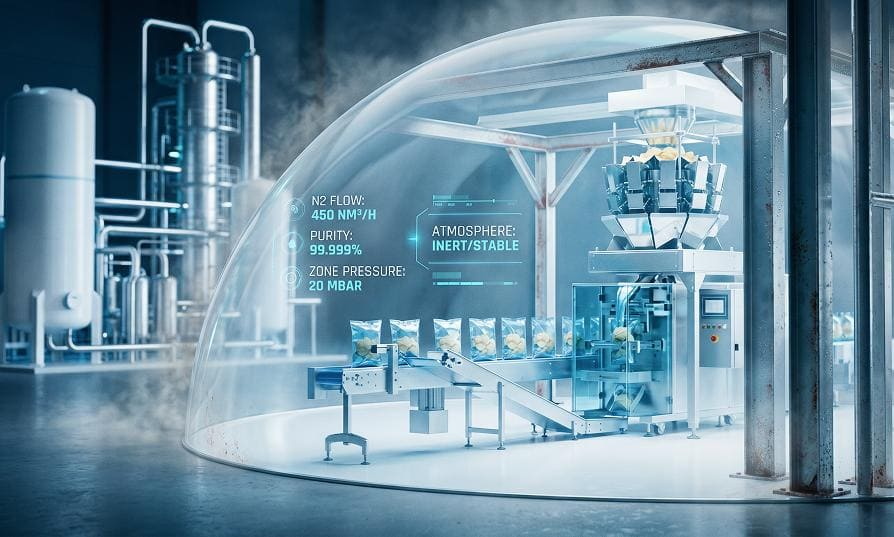
For capacity sizing, our SANGHI-O RG series ranges from 80 m³/hr (Model ORG 80) up to 1,000 m³/hr and beyond. Nitrogen Plant Cost considerations must also account for required purity — 99.5% nitrogen for food packaging versus 99.9999% (1 PPM) nitrogen for semiconductor manufacturing are built and priced differently.
Sanghi Overseas guides every prospective buyer through a structured feasibility process: demand assessment, competitor mapping, technology and capacity selection, site development planning, and a full lifecycle cost analysis.
Making the Switch: What the Process Looks Like
Frequently Asked Questions
Everything buyers ask Sanghi Overseas before making the switch from cylinders to an on-site plant.